


Technology
E2E Networks to Add 5.4 MW for NVIDIA Blackwell GPUs, Lifting AI Cloud Capacity Nearly 59%
E2E Networks to Add 5.4 MW for NVIDIA Blackwell GPUs, Lifting AI Cloud Capacity Nearly 59%
![]() By Elets News Network - 26 October 2026


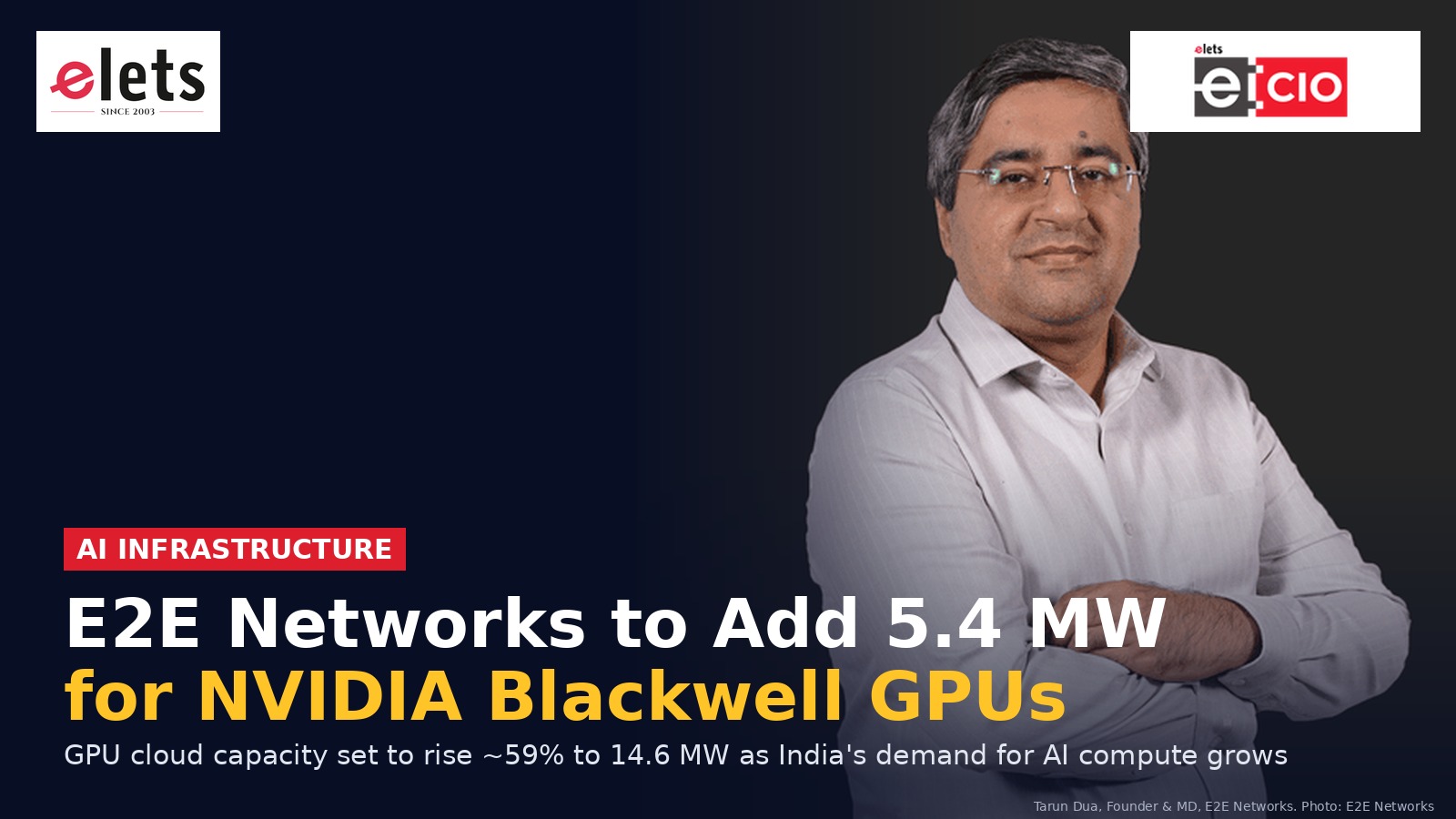
India’s appetite for artificial intelligence compute has pushed another homegrown provider to scale up. E2E Networks, the NSE-listed GPU cloud company, said on Monday, 26 October 2026, that it proposes to add roughly 5.4 megawatts (MW) of infrastructure capacity to host NVIDIA HGX B300 systems and other Blackwell-generation GPUs.
According to the company’s exchange filing, as reported by CNBC-TV18 and Moneycontrol, E2E’s existing footprint stands at about 9.2 MW and is already being used to deliver GPU cloud infrastructure and other AI services. If the new tranche is implemented in full, total capacity would rise to around 14.6 MW, an expansion of close to 59 per cent.
What the filing says, and what it does not
E2E has framed the addition as a response to rising demand for GPUs and related services. The rollout, it said, will follow its infrastructure deployment plan and the demand it expects for AI computing services. Funding is to come from a mix of internal accruals and debt.
The disclosure leaves several questions open. The company has not given a commissioning timeline, a capex figure, or a split between HGX B300 systems and other Blackwell GPUs. It has also not named customers or projected revenue from the new capacity, and said the final investment will depend on the infrastructure that is actually deployed.
Investors responded quickly anyway. Moneycontrol reported that the stock, which had opened the day at its 5 per cent lower circuit after a seven-session losing streak, reversed to hit the 5 per cent upper circuit at about ₹594 after the announcement. The earlier selling came amid global unease over the scale of AI capital expenditure.
Why it matters for India’s AI stack
Access to accelerated compute has become one of the main constraints for Indian AI builders. In a report published on 25 October, Business Standard noted that funding is no longer the only hurdle for the country’s AI companies; GPU deliveries can take three to four months, and teams are increasingly booking capacity well in advance.
Domestic GPU clouds such as E2E sit at an important point in that chain. They give startups, research institutions, enterprises and public programmes a way to rent high-end accelerators locally, with data kept within Indian jurisdiction, rather than relying only on overseas hyperscalers. That matters more as sovereign AI efforts, Indian-language foundation models and government AI deployments move from pilots to production.
Blackwell-class systems such as the HGX B300 are built for large-scale training and, increasingly, for high-volume inference. That is where enterprise demand is heading as companies move generative and agentic AI applications into everyday operations. More of this capacity in India could shorten queues for local model builders and lower latency for AI services that serve Indian users.
What CIOs should watch
For technology leaders, the announcement is a reminder that compute availability, power and data residency are now part of AI strategy, not just procurement. CIOs planning large inference workloads or fine-tuning projects in 2027 will want to track when this capacity actually comes online, how it is priced against global alternatives, and whether domestic providers can secure enough power and chips to keep pace.
E2E’s move is relatively modest next to the gigawatt-scale campuses being planned across the country. Still, it shows that mid-sized Indian AI cloud players are investing to keep up with demand, and that the race for AI infrastructure in India is now about megawatts as much as models.
Be a part of Elets Collaborative Initiatives. Join Us for Upcoming Events and explore business opportunities. Like us on Facebook , connect with us on LinkedIn and follow us on Twitter.
"Exciting news! Elets technomedia is now on WhatsApp Channels Subscribe today by clicking the link and stay updated with the latest insights!" Click here!