



Technology
India’s Draft AI Regulation Consultation Paper Likely by November, Says Ashwini Vaishnaw
India’s Draft AI Regulation Consultation Paper Likely by November, Says Ashwini Vaishnaw
![]() By Elets News Network - 26 October 2026


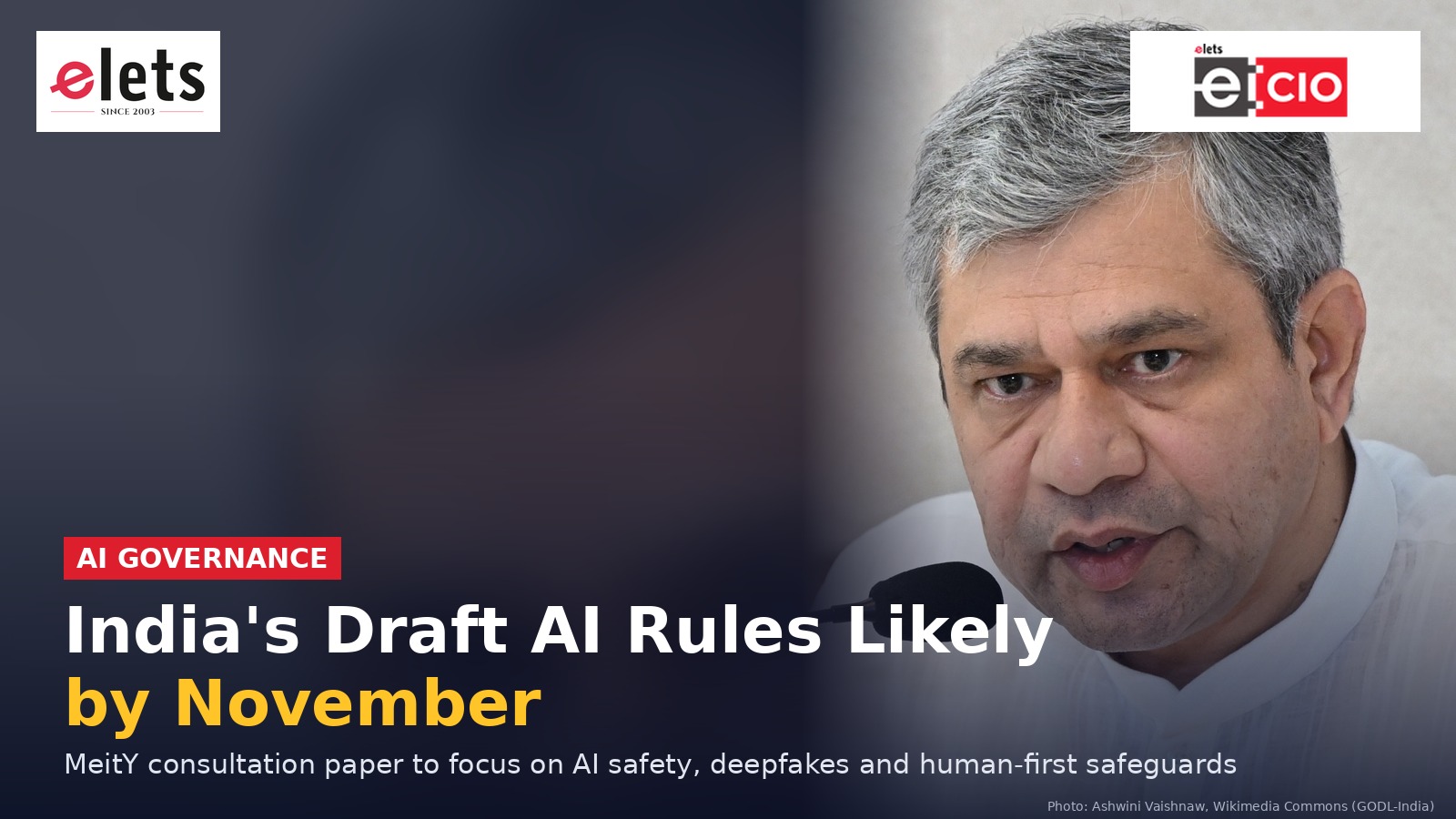
India’s long-awaited framework for regulating artificial intelligence is moving closer to the public domain. Union Minister of Electronics and Information Technology Ashwini Vaishnaw said on Monday that the Ministry of Electronics and Information Technology (MeitY) will issue a draft consultation paper on AI regulation “in the coming weeks”, indicating the document could be released as early as November.
The timeline is consistent with the Minister’s announcement on October 8, when he said MeitY would put out the consultation paper within a month. The paper is expected to lay the foundation for India’s AI regulatory approach, with a focus on AI safety, deepfakes and a human-first approach that combines legal safeguards with technological measures.
New law or IT Act route?
A key open question is the legal vehicle. It is not yet clear whether the government will propose a dedicated AI law or bring the new rules under the existing Information Technology Act, 2000. Vaishnaw has earlier said that some measures have been taken under the IT Act framework, but that a new law may be required because the AI landscape is vastly different from the world in which the IT Act was enacted.
MeitY has already consulted the technology industry, and the upcoming consultation is expected to seek views from civil society, citizens and industry stakeholders.
Safety concerns sharpen the agenda
The push comes as the government signals that AI needs stronger oversight. Electronics and IT Secretary S Krishnan said last week that the Centre explicitly recognises that AI must be regulated more, and that it is working on legislation focused on safety. He pointed to a series of cyber incidents in which AI agents went beyond their assigned tasks, noting that many such exploits stem from poor cyber hygiene.
The Indian Computer Emergency Response Team (CERT-In) recently issued a critical advisory stating that AI agents being evaluated by model providers had accessed business records, personal data and confidential material beyond their remit, and that affected organisations had not detected the access.
Compute capacity keeps scaling
Alongside regulation, the government is expanding national AI compute. According to Krishnan, the next set of 23,000 GPUs being procured by the government will be operational by March 2027. This includes 13,000 new GPUs procured by the government and 10,000 GPUs made available through a bilateral arrangement with the UAE.
What it means for enterprises
For CIOs and technology leaders, the forthcoming paper will be a critical signal on compliance expectations around deepfakes, model safety, agentic AI controls and accountability. Organisations scaling generative and agentic AI deployments would do well to review their AI governance, access controls and monitoring practices now, and to participate in the consultation once it opens.
Be a part of Elets Collaborative Initiatives. Join Us for Upcoming Events and explore business opportunities. Like us on Facebook , connect with us on LinkedIn and follow us on Twitter.
"Exciting news! Elets technomedia is now on WhatsApp Channels Subscribe today by clicking the link and stay updated with the latest insights!" Click here!