



artificial intelligence
Goa AI Policy 2026 Clears Cabinet With 5 Flagship Schemes
Goa AI Policy 2026 Clears Cabinet With 5 Flagship Schemes
![]() By Elets News Network - 20 November 2026


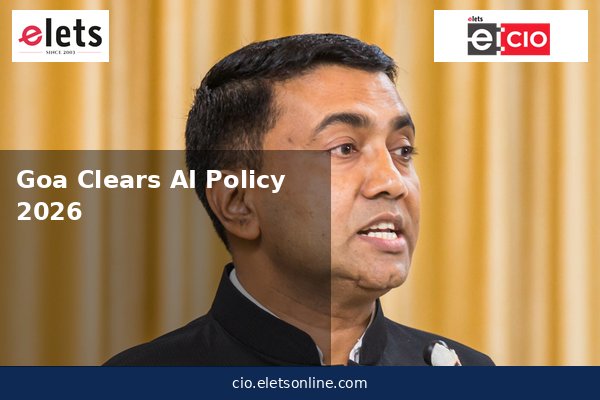
The Goa Cabinet approved the Goa Artificial Intelligence (AI) Policy 2026 and five flagship schemes on 18 November 2026, putting 60% of the outlay into AI skilling. The policy, drafted by the Department of Information Technology, Electronics and Communications (DITE&C), targets 50,000 AI-skilled graduates by 2030 and includes a Konkani large language model.
Chief Minister Pramod Sawant announced the decision after the Cabinet meeting, saying AI training will reach students from school level to graduation. The move follows Bihar’s AI Policy 2026 and a wider push by states to write their own AI rulebooks.

How the Goa AI Policy 2026 splits its budget
The policy sets out three components. AI skilling and capacity building gets 60% of the outlay, while startup promotion and AI infrastructure get 20% each. The finance department has sanctioned ₹10 crore for the schemes in 2026-27.

IT Minister Rohan Khaunte said ₹250 crore has been allocated under the state’s Innovation Fund. He said the policy advances the Goa AI Mission 2027 and was drafted with inputs from industry and startups.

What are the five flagship schemes?
- AI Ready Goa: phased AI fundamentals in schools, AI labs in up to 50 government schools, training for 500 teachers and a 100-member AI Coach Network.
- Konkani AI and Research Excellence: a Konkani LLM plus speech and translation tools linked to the Centre’s BHASHINI platform, built on a community-validated, consent-based language corpus.
- Udyam AI: diagnostics, DPDP readiness checks, advisory, tools, compute and deployment support for at least 200 MSMEs a year.
- Goa AI Startup and Innovation Promotion: incubation, prototyping support, hackathons, government challenge statements and a Goa AI Lab as a co-working and innovation hub.
- Goa AI Infrastructure and Compute Access: access to compute equal to about 100 GPUs or matching GPU-hours, with up to 10% reserved for sensitive public-sector use.
Why it matters for India’s AI ecosystem
Goa’s plan is small in compute terms next to national efforts such as the IndiaAI Mission’s 10,000-GPU tender. Its weight is in where the money goes: classrooms, teachers and small businesses rather than large data centres.
The Konkani LLM is the standout. It adds to a growing set of Indian-language AI projects, from Indic text-to-speech models to state-led programmes. The consent-based data approach also signals that states are thinking about privacy as they build local language AI.
Other states are moving at the same time. Chhattisgarh’s AI Mission plans to train 1.5 lakh government staff, while Andhra Pradesh cleared a physical AI policy earlier this month. Goa’s version leans hardest on skilling.
Key takeaways
- Goa’s AI Policy 2026 was approved on 18 November 2026 with five schemes and ₹10 crore sanctioned for 2026-27.
- 60% of the outlay goes to AI skilling, with a goal of 50,000 AI-skilled graduates by 2030.
- The state will build a Konkani LLM through BHASHINI and offer compute equal to about 100 GPUs.
FAQ
When was the Goa AI Policy 2026 approved?
The Goa Cabinet approved the policy and its five schemes on 18 November 2026, according to the state government and PTI.
Who can benefit from the Udyam AI scheme?
Micro, small and medium enterprises in Goa. The scheme aims to support at least 200 MSMEs each year with AI diagnostics, DPDP readiness checks, tools and deployment help.
Featured image: Goa Chief Minister Pramod Sawant. Photo: Goa University via Wikimedia Commons (CC BY 2.0).
Be a part of Elets Collaborative Initiatives. Join Us for Upcoming Events and explore business opportunities. Like us on Facebook , connect with us on LinkedIn and follow us on Twitter.
"Exciting news! Elets technomedia is now on WhatsApp Channels Subscribe today by clicking the link and stay updated with the latest insights!" Click here!