


News
Global AI Companies Turn to India for Data Centre Capacity as Power Crunch Bites Elsewhere
Global AI Companies Turn to India for Data Centre Capacity as Power Crunch Bites Elsewhere
![]() By Elets News Network - 26 October 2026


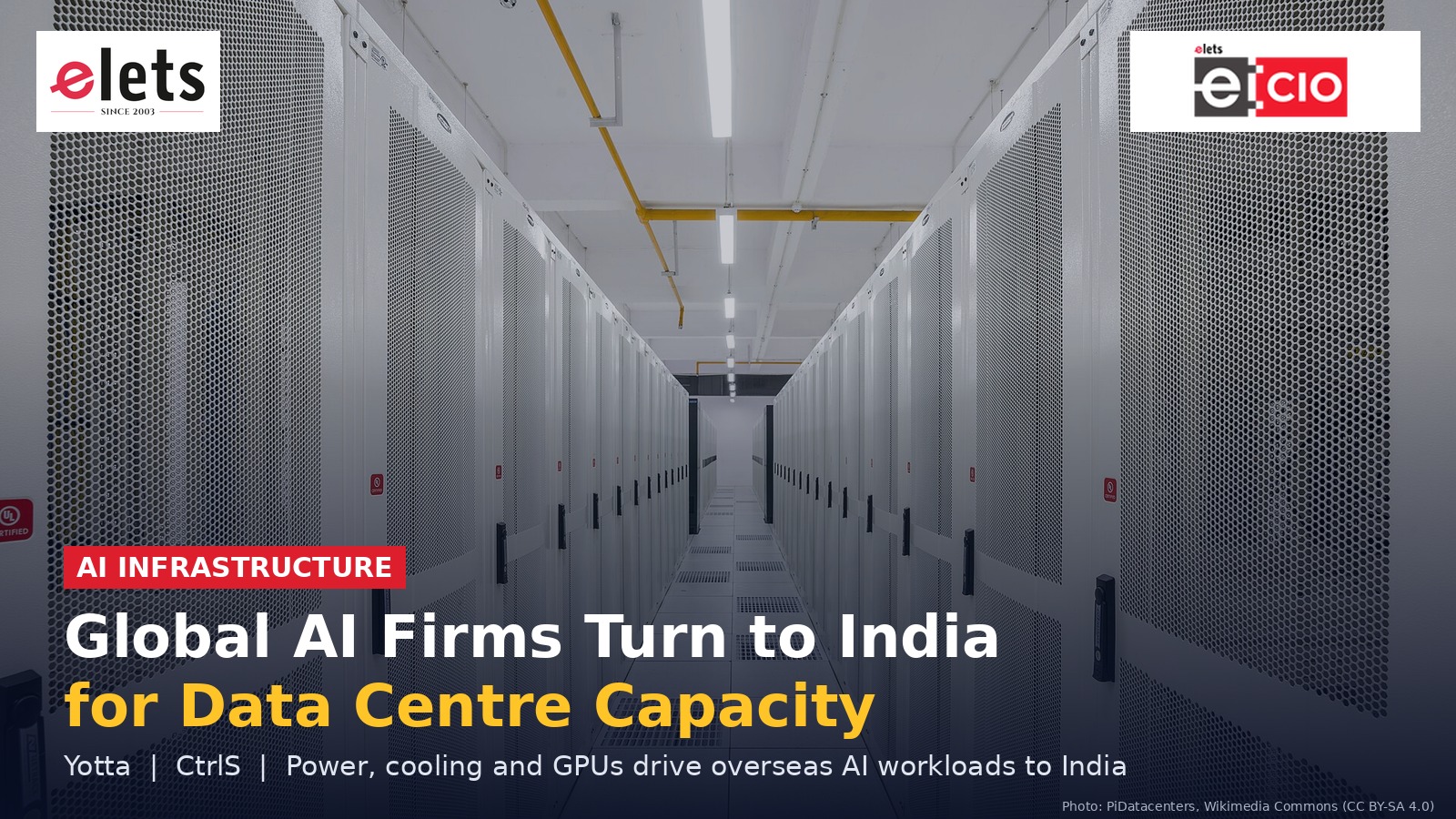
India’s data centres are no longer serving only Indian users. Global artificial intelligence companies, squeezed by power and capacity shortages in their home markets, are increasingly running workloads for overseas customers out of Indian facilities, according to data centre operators quoted in a Times of India report on 26 October 2026.
The shift signals a new role for the country in the global AI supply chain: not just a fast-growing market for AI services, but an overflow compute hub that international model builders and AI platforms can tap when capacity elsewhere is stretched.
Overseas AI workloads, hosted from India
Sunil Gupta, co-founder, CEO and Managing Director of Yotta Data Services, which operates data centres and rents out AI computing capacity, said the company is already hosting some international customers and has contracted large capacities with several of them. He noted that these customers are using infrastructure hosted and operated from India to serve workloads that extend well beyond the country.
At CtrlS Datacenters, founder and CEO Sridhar Pinnapureddy described how quickly demand is scaling. Conversations that begin with a requirement of around 20 megawatts can rapidly expand to 100 MW or more. In his view, AI is compressing the time operators have to respond while dramatically increasing the scale they must build for, which means higher power densities and advanced cooling now have to be planned together with land, transmission and future expansion.
Why global players are spreading their compute
The trigger is a global crunch. Securing grid power, cooling and data centre space has become a multi-year exercise in several established markets, and AI companies are spreading their infrastructure across countries to avoid being held back by any single location. India, with a growing pipeline of hyperscale and AI-ready campuses, is emerging as one of the beneficiaries.
The policy environment is also supportive. Under the ₹10,372 crore IndiaAI Mission, 14 companies that onboarded GPUs to the national compute pool, including Yotta, CtrlS, Tata Communications, Jio Platforms, E2E Networks and NxtGen, have been permitted to sell capacity to global customers at commercial rates, so that they remain viable while domestic uptake builds. The mission’s shared pool already exceeds 38,000 GPUs, and the government is now seeking up to 10,000 more compute units with five-year usage commitments.
Constraints at home remain real
The opportunity sits alongside persistent bottlenecks. Indian AI builders report waits of three to six months for GPUs, while high-bandwidth memory, specialised cooling and reliable high-density power continue to slow deployments. Larger hyperscalers that reserve space and power years in advance can also crowd out smaller customers. Balancing export demand with the compute needs of Indian startups, researchers and public institutions will be an important test for operators and policymakers alike.
What it means for CIOs
For enterprise technology leaders, the trend points to a maturing domestic AI infrastructure market, with more choice in sovereign and India-hosted GPU capacity, but also to growing competition for that capacity. CIOs planning large AI deployments should lock in compute, power and cooling roadmaps early, weigh long-term capacity contracts against flexible cloud options, and keep data residency and governance requirements front and centre as global and domestic workloads share the same facilities.
As AI demand outpaces infrastructure worldwide, India’s ability to deliver power, cooling and capacity at speed could make it a strategic node in the global AI economy.
Be a part of Elets Collaborative Initiatives. Join Us for Upcoming Events and explore business opportunities. Like us on Facebook , connect with us on LinkedIn and follow us on Twitter.
"Exciting news! Elets technomedia is now on WhatsApp Channels Subscribe today by clicking the link and stay updated with the latest insights!" Click here!