


Article
AI in India: From Digital Public Infrastructure to Global Leadership
AI in India: From Digital Public Infrastructure to Global Leadership
![]() By Elets News Network - 01 August 2026
By Elets News Network - 01 August 2026


“The future of artificial intelligence will not be defined only by who builds the most advanced models, but by who can use AI to solve real-world problems at scale.”
For years, conversations around artificial intelligence were dominated by developments in Silicon Valley, Europe, and China. India was often considered a large consumer market for technology rather than a country shaping its future. That perception is changing rapidly.
Today, India is building an AI ecosystem unlike any other. Instead of relying solely on breakthrough research or massive investments from a handful of technology giants, the country is combining its strengths in digital public infrastructure, government-backed innovation, entrepreneurial energy, and one of the world’s largest technology talent pools. The result is an AI journey that is uniquely Indian, focused on solving real-world problems at scale.
From farmers receiving AI-powered weather recommendations to hospitals using intelligent diagnostics, from multilingual language models serving millions of citizens to startups developing enterprise AI for global customers, artificial intelligence is becoming deeply embedded in India’s growth story.
The question is no longer whether India will participate in the AI revolution.
The real question is: Can India become one of its global leaders?
The answer depends on how effectively the country combines technology, policy, innovation, infrastructure, and talent over the next decade.
The AI Revolution Started Before AI Became a Buzzword
Artificial intelligence does not exist in isolation. It needs reliable digital infrastructure, trusted data systems, secure identity verification, digital payment networks, cloud connectivity, and millions of active users.
Long before ChatGPT introduced generative AI to the mainstream, India had already spent more than a decade building exactly these foundations.
The country’s Digital Public Infrastructure has become one of the most admired examples of technology-enabled governance worldwide. Instead of creating isolated digital services, India developed interoperable platforms that work together across sectors, allowing governments, startups, financial institutions, healthcare providers, and businesses to innovate on a common digital framework.
Platforms such as Aadhaar, UPI, DigiLocker, CoWIN, FASTag, the Account Aggregator framework, and the Open Network for Digital Commerce (ONDC) have transformed the way citizens access public and private services.
Take UPI as an example. What began as a digital payments platform has evolved into one of the world’s largest real-time payment ecosystems, processing billions of transactions every month. For AI developers, platforms like UPI are more than digital utilities; they represent structured, scalable ecosystems capable of supporting intelligent financial services, fraud detection, customer personalization, and predictive analytics.
Similarly, Aadhaar has simplified identity verification for over a billion citizens, while DigiLocker has made secure digital documentation commonplace. These systems generate trusted digital interactions that can support AI-driven innovation across sectors without requiring organizations to build entirely new infrastructure from scratch.
This is where India’s AI Ecosystem becomes unique. Instead of asking, “How do we build AI?” India has first answered a more fundamental question:
“How do we build the digital ecosystem that allows AI to create meaningful impact?”
Government Initiatives Are Accelerating the AI Journey
Technology alone cannot drive transformation. Policy, investment, and long-term vision are equally important.
Recognising AI as a strategic growth engine in India, the Government of India has placed artificial intelligence at the centre of its digital development agenda. The IndiaAI Mission is a major step in this direction, focusing on strengthening AI infrastructure, expanding access to computing resources, supporting indigenous AI models, improving datasets, promoting research, and developing skilled professionals.
Beyond infrastructure, the mission is designed to democratise AI by ensuring that startups, educational institutions, researchers, and enterprises have access to the resources needed to innovate.
At the same time, India is working towards creating responsible AI frameworks that balance innovation with transparency, accountability, and trust. As AI becomes increasingly integrated into governance, healthcare, financial services, and education, ensuring ethical deployment will be just as important as advancing the technology itself.
The government’s continued investments in semiconductor manufacturing, data centres, cloud infrastructure, and digital connectivity further strengthen the country’s AI ambitions and create an environment where innovation can scale rapidly.
A Startup Ecosystem Driving Practical Innovation
India’s startup ecosystem has become one of the strongest pillars of its AI journey.
Over the past decade, the country has emerged as one of the world’s largest startup hubs, with entrepreneurs building solutions across healthcare, agriculture, fintech, education, manufacturing, logistics, retail, cybersecurity, and enterprise technology. Artificial intelligence is now at the heart of much of this innovation.
What makes India’s startup landscape particularly interesting is its focus on solving real-world problems rather than simply showcasing cutting-edge technology. AI is being used to improve healthcare access in rural communities, optimise agricultural productivity, automate business operations, strengthen cybersecurity, and enhance customer experiences across industries.
Increasingly, these startups are building products for global markets, demonstrating that India is not only consuming AI technologies but also exporting innovation to the world.
India’s Talent Advantage Continues to Grow
Every AI revolution is ultimately powered by people.
India has long been recognised for its deep pool of engineering and technology talent, and this continues to be one of the country’s greatest competitive strengths. Each year, universities produce hundreds of thousands of graduates in engineering, computer science, and related disciplines, while the IT industry continues to invest heavily in workforce development.
Today, AI has become a key focus of that effort. Educational institutions are introducing specialised AI programmes, research organisations are expanding collaborations with industry, and businesses are investing in upskilling employees in machine learning, data science, cloud computing, and generative AI.
Global technology companies are also strengthening their presence across Bengaluru, Hyderabad, Pune, Chennai, Gurugram, and Noida through Global Capability Centres (GCCs). These centres have evolved far beyond traditional support functions and are increasingly leading global AI research, engineering, product development, and innovation.
Combined with a vibrant developer community and a growing entrepreneurial culture, India’s talent ecosystem provides a strong foundation for long-term AI leadership.
India’s AI Growth by the Numbers
India’s AI momentum is supported by strong digital adoption and sustained investment across both the public and private sectors.
Key indicators highlight the scale of this transformation:
- India is home to one of the world’s largest software developer communities.
- UPI processes billions of digital transactions every month, making it one of the largest real-time payment systems globally.
- India has one of the world’s fastest-growing startup ecosystems, with AI attracting increasing investment.
- Industry estimates suggest AI could contribute hundreds of billions of dollars to India’s economy by the end of this decade.
- Investments in data centres, cloud infrastructure, semiconductor manufacturing, and AI computing capacity continue to grow rapidly.
- India’s multilingual landscape is driving the development of language AI solutions capable of serving diverse populations.
Together, these indicators reflect a country that is not only adopting AI rapidly but also building the infrastructure needed for sustained innovation.
Challenges on the Road to Global Leadership
India’s progress has been remarkable, but the journey is far from complete.
Expanding access to advanced AI computing infrastructure, strengthening domestic research capabilities, improving the availability of high-quality datasets, and encouraging deeper collaboration between academia and industry will remain important priorities.
Equally critical is the need to build robust governance frameworks that promote responsible AI while protecting privacy, ensuring cybersecurity, and maintaining public trust.
Addressing these challenges will determine how successfully India transitions from being one of the world’s largest AI adopters to becoming one of its leading innovators.
Be Part of the Conversation at World AI Summit 2026
As artificial intelligence reshapes industries, economies, and governments across the world, collaboration between policymakers, business leaders, researchers, startups, and technology innovators has never been more important.
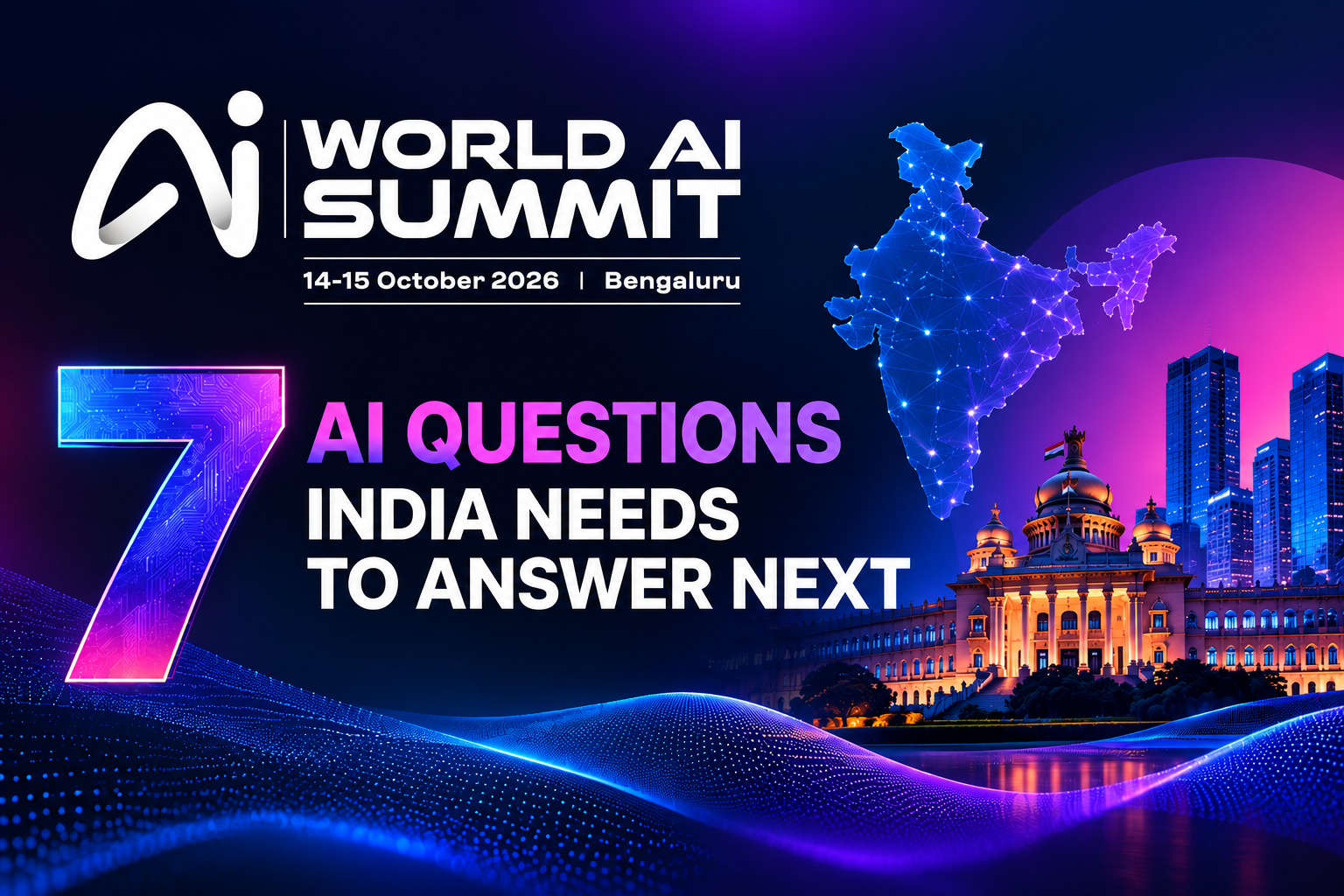
World AI Summit 2026, taking place on 14–15 October 2026 in Bengaluru, will bring together global AI leaders to discuss the technologies, strategies, and partnerships driving the next era of innovation. From Generative AI and enterprise transformation to Digital Public Infrastructure, AI governance, intelligent automation, startups, and investment, the summit will explore how AI events in Bengaluru are creating new opportunities for businesses and societies alike.
For organisations looking to accelerate their AI journey, and for professionals eager to understand where the technology is headed, World AI Summit 2026 offers a unique platform to connect, collaborate, and learn from some of the brightest minds shaping the future of artificial intelligence. As India strengthens its position on the global AI map, there has never been a better time to be part of the conversation.
For more information, visit: https://www.worldaisummit.com
Be a part of Elets Collaborative Initiatives. Join Us for Upcoming Events and explore business opportunities. Like us on Facebook , connect with us on LinkedIn and follow us on Twitter.
"Exciting news! Elets technomedia is now on WhatsApp Channels Subscribe today by clicking the link and stay updated with the latest insights!" Click here!