


artificial intelligence
Quad Pledges Over $85 Million to Widen Access to Trusted AI Across the Indo-Pacific, Will Map Chip and AI Hardware Chokepoints
Quad Pledges Over $85 Million to Widen Access to Trusted AI Across the Indo-Pacific, Will Map Chip and AI Hardware Chokepoints
![]() By Elets News Network - 01 November 2026


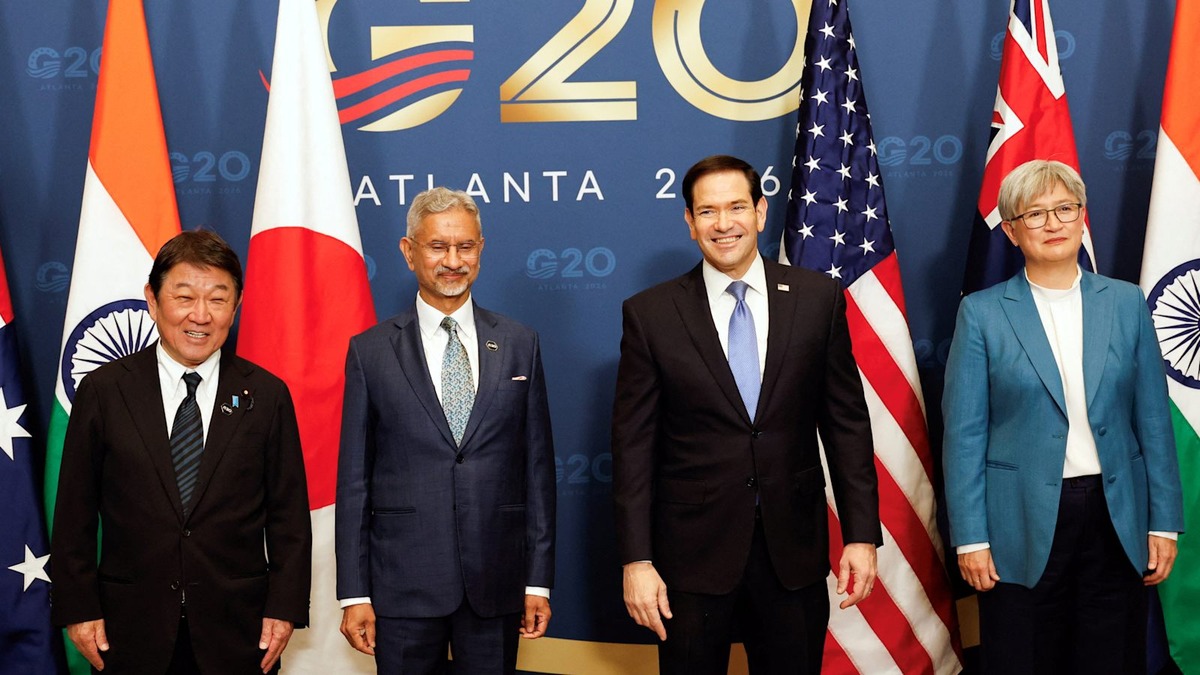
Artificial intelligence has moved to the centre of the Quad’s economic agenda. Meeting in Atlanta, Georgia, on 31 October on the sidelines of the G20 Foreign Ministers’ Meeting, External Affairs Minister S Jaishankar, US Secretary of State Marco Rubio, Japan’s Foreign Minister Toshimitsu Motegi and Australia’s Foreign Minister Penny Wong said their countries intend to provide more than $85 million in technical and financial assistance to support access to trusted AI across the Indo-Pacific.
The commitment was set out in a Quad Joint Press Release on Economic Prosperity and Security issued after the meeting, which also covered semiconductors, telecom networks, critical minerals and cybersecurity. It was the grouping’s third foreign ministers’ meeting this year, after New Delhi in May and Manila in July.
What the Quad has committed on AI
According to the joint statement, the ministers highlighted the importance of AI and initiatives such as Pax Silica to future economic growth, and said the assistance would flow in part through the Quad AI Accelerator. The joint text uses the term “Super Intelligence (SI)”, with a footnote clarifying that in Australia, India and Japan the term refers to artificial intelligence.
The statement does not say how much each country will contribute, which countries will receive support first, or how the money will be allocated. Those details will decide whether the pledge becomes a meaningful capacity-building programme for smaller economies in the region or remains a headline number.
Chips and AI hardware: finding chokepoints early
The more structural commitment may be on hardware. The four countries said they will launch a new effort to identify semiconductor and AI hardware supply-chain chokepoints before they cause disruptions, reinforcing the need for secure, resilient and trusted supply chains for advanced, leading-edge chips.
The ministers also voiced “grave concerns” about economic coercion, including arbitrary export restrictions, and about non-market practices that create overcapacity in critical industries. The statement did not name any country, but the language reflects a year in which access to GPUs, memory and rare earths has become a strategic question rather than a purely commercial one.
Networks, identity and cyber
On telecom, the Quad committed to identifying priority countries for cooperation on trusted 5G, 6G, Open RAN and AI-enabled radio access networks, and to building a pipeline of trusted 5G projects. The partners said they continue to map digital identity standards so that public and private sectors can work together more easily, and noted that senior Quad cyber officials met this month to continue work on a trusted and resilient cybersecurity environment.
The ministers also condemned criminal groups that traffic people into scam compounds and use them to defraud citizens, a threat that AI-generated voices and deepfakes are making harder to spot, and committed to dismantling these operations.
Critical minerals and a business forum
Alongside the AI pledge, the ministers welcomed a US commitment of $10 million to promote infrastructure and facilities in India and ASEAN countries that recover critical minerals from electronic waste and scrap, under the Quad Critical Minerals Initiative Framework announced in May. They also announced the first Quad Business Leaders’ Forum to connect industry and government, while the Quad’s export credit agencies are due to meet in Tokyo on 18 November.
“As our nations continue building reliable and open supply chains, supporting next-generation technologies, increasing maritime cooperation and securing critical minerals, the United States, Australia, India and Japan are delivering results for our people and the nations in the region,” Rubio said, according to ANI.
Why it matters for India
For India, the Atlanta outcomes connect several national priorities. The IndiaAI Mission is scaling subsidised GPU access for startups and researchers, the India Semiconductor Mission is building out fabrication and assembly capacity, and Indian enterprises are moving AI from pilots into production. Each of these depends on reliable access to advanced chips, AI hardware and the minerals inside them.
A Quad-level effort to map chokepoints, together with recycling investment that turns e-waste into a domestic source of critical minerals, could ease some of that exposure. India’s experience in building digital public infrastructure at population scale also gives it a natural role in shaping how “trusted AI” support is delivered to other countries in the region.
The next test is detail: who funds what, which partner countries are prioritised, and how the AI Accelerator works in practice. With a Quad Leaders’ Summit expected soon, CIOs and AI leaders will be watching for those answers.
Be a part of Elets Collaborative Initiatives. Join Us for Upcoming Events and explore business opportunities. Like us on Facebook , connect with us on LinkedIn and follow us on Twitter.
"Exciting news! Elets technomedia is now on WhatsApp Channels Subscribe today by clicking the link and stay updated with the latest insights!" Click here!