


artificial intelligence
CopperPilot Raises $390,000 Pre-Seed, Opens Epsilon AI Agent That Designs Circuit Boards From Plain English
CopperPilot Raises $390,000 Pre-Seed, Opens Epsilon AI Agent That Designs Circuit Boards From Plain English
![]() By Elets News Network - 31 October 2026


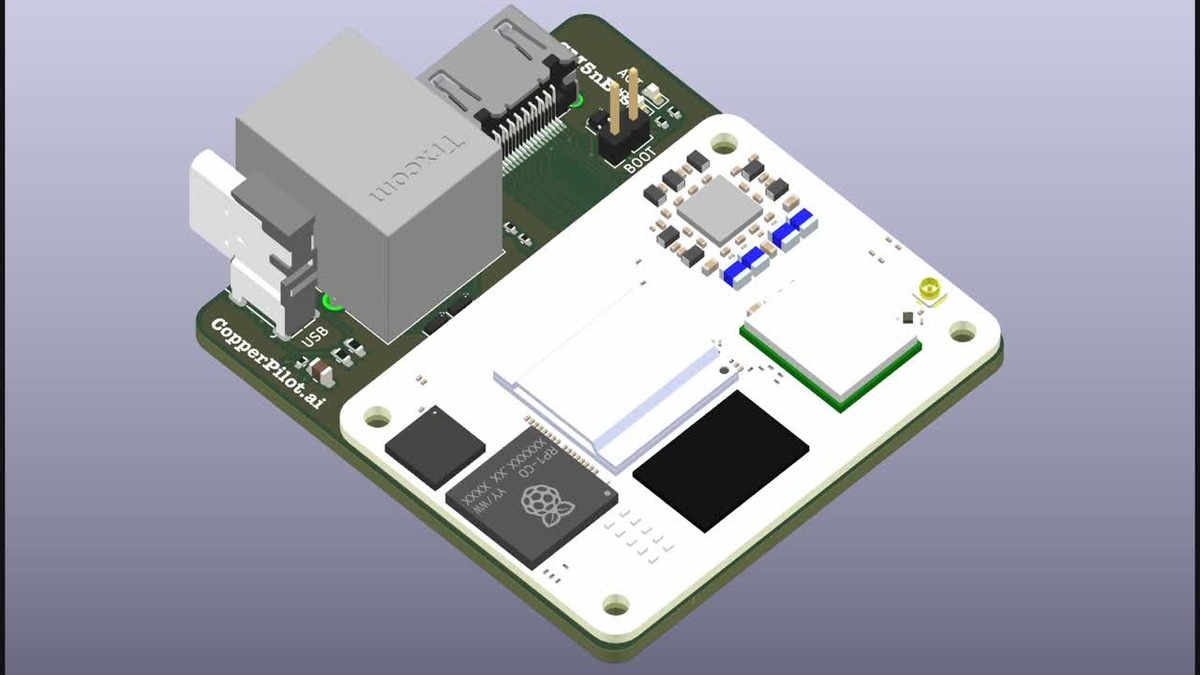
AI coding agents have changed how software gets written. Hardware has largely been left out of that shift: designing the electronics for a new product still means reading datasheets line by line, picking parts, drawing schematics and routing every connection on a printed circuit board by hand. CopperPilot, a startup with an engineering team in Bengaluru, wants to bring the same agentic leap to the circuit board.
The company has raised $390,000 in a pre-seed round led by Neon Fund, with participation from US-based angel investors, and has opened version 1 of its AI design agent, codenamed Epsilon, to hardware engineers.
From a plain-English brief to a manufacturable board
Epsilon takes a description of what an engineer wants to build and works through the design flow end to end. According to the company, it researches the requirements, reads component datasheets, shortlists parts and offers alternatives, draws schematics and custom footprints, places and routes the board, and then checks its own work against electrical rule checks (ERC), design rule checks (DRC) and manufacturing constraints.
When requirements are incomplete or a component does not meet a constraint, the agent asks for clarification rather than guessing. With a clear brief it can run a sequence of tasks on its own, while engineers can step in and review at any stage. For designs heading to the factory, it produces a review report that separates blocking issues from minor ones and prioritises fixes.
Co-founder and CEO Aditya NG has said the agent is built to catch mistakes that standard rule checks miss, such as reversed transmit and receive lines on a serial link between two chips, a common error that can force a costly board “re-spin”.
Working inside the tools engineers already use
Rather than asking teams to move to a new platform, CopperPilot works inside existing electronic design automation (EDA) software. Its deepest integration today is with the open-source tool KiCad, with early support for Altium and LTspice. Epsilon can also be called from AI coding agents such as Claude Code, Cursor and Codex, so developers can hand off a board-design task without leaving their environment.
What the numbers say
The startup published an internal benchmark of 341 KiCad tasks across 49 real designs, graded by KiCad’s own checks rather than an AI judge. Running on the same underlying language model, Epsilon scored 83.2 overall against 54.7 for a general-purpose agent. On full end-to-end board builds from an empty project, the gap widened to 78.0 versus 18.6. The company says Epsilon designed an eight-layer board for a Raspberry Pi-based AI camera in about 30 minutes, and has also produced NVIDIA Jetson carrier boards and drone circuit boards.
CopperPilot says weekly active users have grown 25-fold since August 2026, with more than 6,000 design tasks run on the platform. It estimates that electronics work from schematic to first prototype typically takes 6 to 15 weeks and $7,500 to $30,000, and claims its agent can compress that to hours. The team also publishes an open-source board design on LinkedIn every day.
Founders, customers and plans
CopperPilot was founded in October 2025 by Aditya NG (CEO), Anish Harsha (COO) and Mohit Bagur, who leads business operations. The founders bring backgrounds in autonomous vehicles, quantum photonics and robotics; Aditya previously worked on autonomous vehicle projects at Purdue University and at Minus Zero.
“I built CopperPilot so that no hardware team is ever blocked because a board is too hard to design,” Aditya said.
The company sells on a subscription model, from a free Starter tier to paid individual, team and enterprise plans, and reports paying customers across the US, UK and Europe alongside users in India. UK warehouse-robotics firm Dexory is among its customers. The new capital will go into product research and engineering, making the agent faster and more reliable, and growing the engineering team.
Siddhartha Ahluwalia, managing partner at Neon Fund, said hardware has been “left behind” by the AI agent wave and is still slowed by datasheets, manual layout and costly re-spins.
Why it matters
India’s push into electronics manufacturing, semiconductors, EVs and robotics depends on a deep bench of hardware design talent. Agents that can take on the repetitive, error-prone parts of board design could shorten iteration cycles for Indian hardware startups and design-services firms, and show that domain-specific tooling, not just a bigger model, is what makes enterprise AI agents reliable.
Be a part of Elets Collaborative Initiatives. Join Us for Upcoming Events and explore business opportunities. Like us on Facebook , connect with us on LinkedIn and follow us on Twitter.
"Exciting news! Elets technomedia is now on WhatsApp Channels Subscribe today by clicking the link and stay updated with the latest insights!" Click here!