


Interview
Engineering at Internet Scale: LinkedIn Leaders on Reliability, AI, and the Future of Distributed Systems
Engineering at Internet Scale: LinkedIn Leaders on Reliability, AI, and the Future of Distributed Systems
![]() By cioNetworks - 20 July 2026
By cioNetworks - 20 July 2026


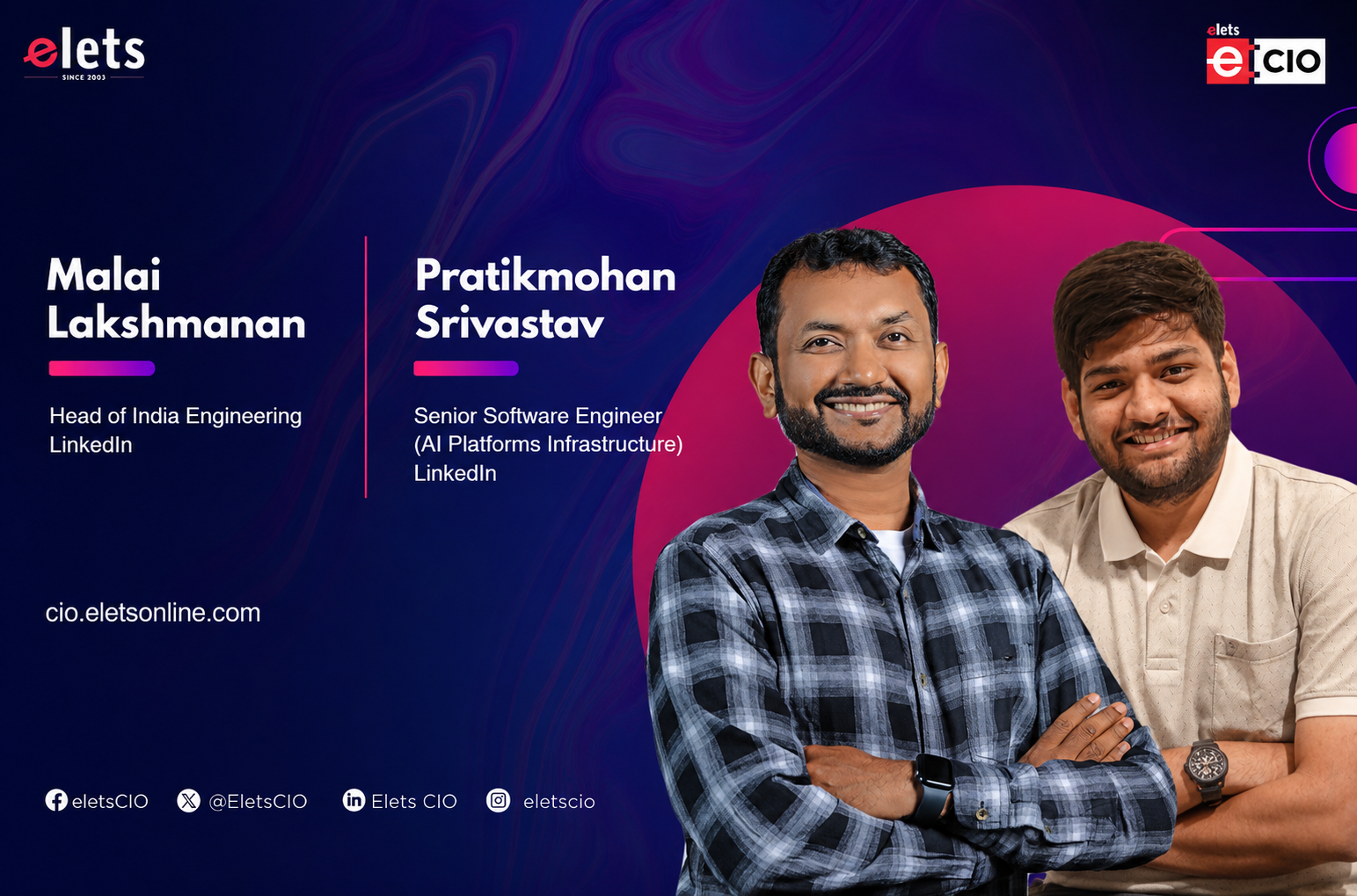
In an exclusive interaction with Elets News Network, Malai Lakshmanan, Head of India Engineering at LinkedIn, and Pratikmohan Srivastav, Senior Software Engineer (AI Platforms Infrastructure) at LinkedIn, share their perspectives on engineering at hyperscale, the evolving role of AI in software development, and the lessons emerging from one of LinkedIn Engineering’s recent large-scale infrastructure incidents. While Malai Lakshmanan responds to the opening question on balancing rapid innovation with long-term infrastructure reliability, the subsequent questions are answered by Pratikmohan Srivastav, who offers detailed technical insights into distributed systems, scalability, observability, engineering fundamentals, and the mindset required to build resilient internet-scale platforms.
Q1. As Head of India Engineering at LinkedIn, how do you ensure engineering teams maintain a balance between rapid innovation and long-term infrastructure reliability, especially in an era increasingly influenced by AI-assisted development?
At LinkedIn’s scale, innovation and reliability go hand in hand. It reinforces that even the smallest details can have an outsized impact, so we stay deeply grounded in engineering fundamentals while moving fast. As AI accelerates development, our focus is on pairing that speed with strong guardrails such as clear SLO ownership, deep observability across the stack, and disciplined testing to catch edge cases early. We’re also intentional about building engineering judgment, because while AI can speed up how we write code, it’s still engineers who ensure systems behave reliably in complex, real-world conditions. We also think about scale more proactively. It’s not just about scaling infrastructure, but about designing systems, data structures, and workflows with worst-case behavior in mind. That requires first-principles thinking and a culture that values understanding how systems behave under load and not just in ideal conditions. Ultimately, the balance comes from building a culture that can move quickly without losing rigor.
Q2. Recently, LinkedIn Engineering shared an incident involving a massive system freeze triggered during the resizing of a HashMap handling nearly 58 million keys, exposing deeper challenges around memory allocation and infrastructure behavior at hyperscale. What did this incident reveal about the hidden complexities of operating distributed systems at internet scale?
The most striking part of the 58-million-key freeze is that nothing in the code was technically wrong, it was a standard HashMap behaving as designed and ended up pausing an entire shard for 10–15 seconds. What this revealed is that at the internet scale, complexity doesn’t sit in one place, it emerges from how systems interact. In this case, the interplay between application code, memory allocation, and kernel-level behavior created a cascading impact. It’s a reminder that abstractions start to break down at scale. Even simple operations can ripple across layers in unexpected ways, which is why building reliable systems requires deep, cross-stack understanding and not just clean architecture, but a clear view of how every layer behaves under real-world conditions.
Q3. The incident highlighted how traditional assumptions around backend performance and data structures can break under extreme workloads. How does LinkedIn rethink scalability, system architecture, and engineering practices when dealing with such large-scale infrastructure challenges?
What this revealed is that at hyperscale, traditional assumptions don’t always hold. Something designed to be efficient in theory can behave very differently under extreme workloads. It changes how you think about system design, we don’t just plan capacity for infrastructure anymore, we plan it for data structures and critical code paths as well. Large operations like memory allocation are treated with the same rigor as I/O: they need to be sized, controlled, and budgeted. More broadly, we design with the expectation that any “fast path” can become a bottleneck under scale. That mindset drives how we build systems today, grounded in worst-case behavior, not just expected behavior.
Q4. At platforms serving hundreds of millions of users, even minor inefficiencies can cascade across services. How do LinkedIn’s engineering teams approach observability, resilience, and proactive issue detection to prevent isolated technical problems from becoming large-scale disruptions?
At this scale, even small inefficiencies can cascade quickly, so observability becomes critical. What stood out here is that traditional metrics could tell us something was wrong, but not why, especially for issues that appear and resolve in seconds. That’s pushed us to rethink how we detect and diagnose problems. Instead of only monitoring symptoms, we invest in deeper, real-time instrumentation that can capture what’s happening across layers the moment an issue occurs. Ultimately, resilience comes down to three things: clear SLOs that surface even short-lived disruptions, proactive observability built in ahead of time, and a culture that treats small anomalies as early signals not noise. That’s how we stay ahead of issues before they scale.
Q5. The incident also reinforced how foundational computer science concepts like memory management, data structures, and system efficiency remain critical despite advancements in cloud and AI technologies. Do you believe the industry is returning to a stronger focus on engineering fundamentals?
Strongly, yes. If anything, this has reinforced it. What stood out here is that the trigger was ultimately a very fundamental behavior in how data structures work at scale. Cloud and AI don’t replace these basics, they amplify their impact. When you operate at this level, things like memory allocation, data structure growth, and system efficiency become first-order concerns, not implementation details. What we’re seeing, both at LinkedIn and across the industry, is a renewed focus on first-principles engineering. AI can accelerate how we build, but the underlying constraints of systems don’t change and engineers who deeply understand those fundamentals are more critical than ever.
Also Read: How miniOrange is taking Indian cybersecurity to the World
Q6. Beyond the technical learnings, what broader lessons did this experience offer about engineering culture, scale preparedness, and the mindset required to build systems that can operate reliably under unpredictable real-world conditions?
One of the most important cultural lessons is not to ignore what looks like “small” or self-resolving behavior. It’s easy to dismiss brief anomalies, but we’ve learned that these are often early signals of deeper systemic issues. For us, scale preparedness is about respecting these seemingly simple failure modes and investing ahead of time in the tools and visibility to understand them. That means strong observability, clear SLOs, and a mindset that prioritizes curiosity over complacency. So we invest deeply in the unglamorous layers such as allocators, kernel locks, data-structure sizing and we invest in the cultural habit of treating small, unexplained anomalies as the most important signals we have. The 58-million-key story is, in the end, less about a bug and more about a culture that refuses to look away from one.
Be a part of Elets Collaborative Initiatives. Join Us for Upcoming Events and explore business opportunities. Like us on Facebook , connect with us on LinkedIn and follow us on Twitter.
"Exciting news! Elets technomedia is now on WhatsApp Channels Subscribe today by clicking the link and stay updated with the latest insights!" Click here!