


artificial intelligence
Salesforce Gives CIOs a Kill Switch for AI Agents, Adds Live Evals and Hard Spending Caps to Agent Fabric
Salesforce Gives CIOs a Kill Switch for AI Agents, Adds Live Evals and Hard Spending Caps to Agent Fabric
![]() By Elets News Network - 01 November 2026


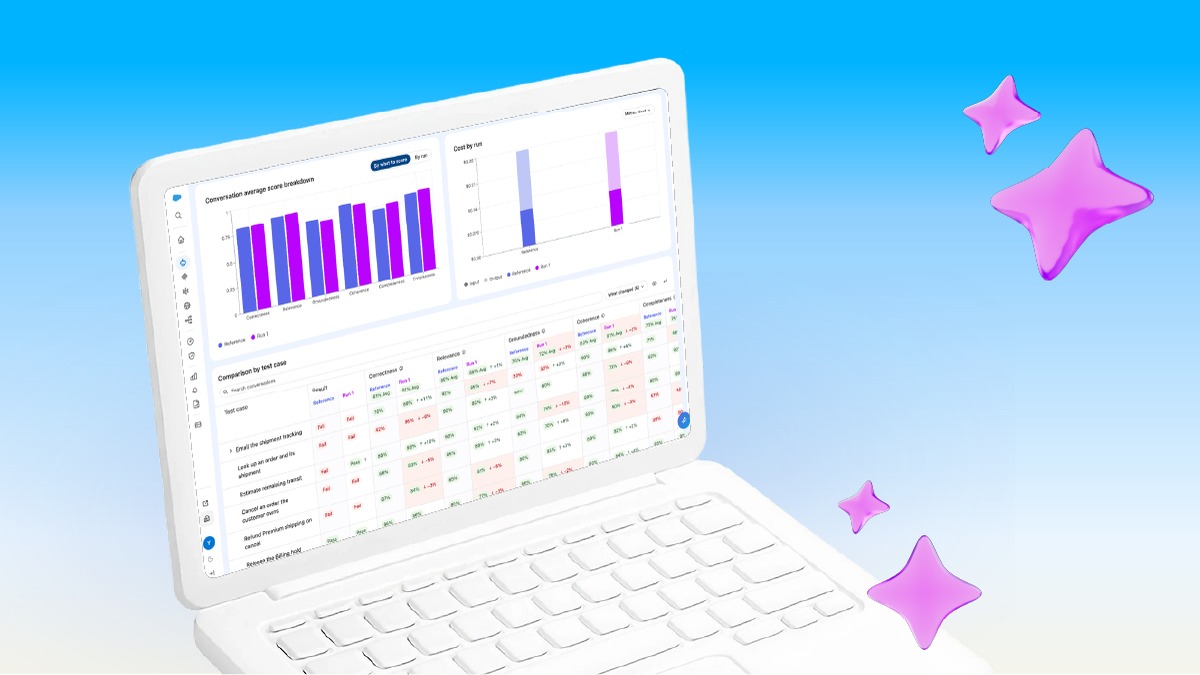
Salesforce has added continuous testing, automatic intervention and hard spending caps to Agent Fabric, its control plane for managing AI agents across platforms. The update, announced on 1 November, is aimed at a problem many enterprises discover only after they move agents into production: an agent can quietly start giving wrong answers or burning through tokens long before a customer complaint or a monthly bill reveals it.
The headline addition is Agent Evals, which tests agents before they go live and keeps scoring them against quality thresholds once they are running. When an agent falls short, the system can trigger a pre-agreed response, up to and including pulling the agent offline through an Agent Kill Switch, with a human sign-off where a company’s policy requires one.
What is new in Agent Fabric
Salesforce describes Agent Fabric as a single place to discover, govern and now evaluate agents, whether they are built on Salesforce or on other platforms. The company says the service already handles more than 1.2 billion requests a day. The new capabilities are:
- Agent Evals: automatically generated pre-deployment tests, followed by ongoing evaluation of agents, large language models and MCP (Model Context Protocol) servers in production against defined quality thresholds.
- API Evals: functional and performance tests generated from API specifications, so a change in an API that an agent depends on is caught before it breaks the agent in production.
- Advanced cost controls: a FinOps Dashboard and Model Wallet that give budget owners one view of AI spending and hard limits that block requests once a budget is reached, plus Cost Optimization Policies that Salesforce says cut token usage by up to 75% in test scenarios through semantic caching, payload compression and response trimming.
- Custom Agent Scanner: lets companies build their own scanners to find and catalogue agents, models, MCP servers and APIs running behind firewalls or on third-party platforms in the Agent Registry, without registering each one by hand.
- Open Policies for Federated API Gateways: applies a single policy, such as IP allowlisting or rate limiting, across API gateways from Azure, Apigee and Kong in one action.
Why it matters: from pilots to accountable production
Salesforce argues that fewer than half of organisations running agents evaluate them on live traffic, even though 96% of enterprises run agents on more than one platform. In that setting, noticing a problem and stopping it are often two separate jobs owned by different teams, and an agent can keep producing bad output while someone tracks down who has the authority to switch it off.
“Enterprises can only scale agents as fast as they can keep them accurate and on budget,” said Andrew Comstock, SVP and GM, MuleSoft and Agent Fabric. “Agent Fabric unifies them, bringing evaluations, cost controls, and intervention together so teams can contain issues instantly and scale agents with confidence.”
The company illustrated the workflow with a retailer that moves its order-support agent to a cheaper model to save money. Scheduled tests spot that the agent has started giving inaccurate information about delayed orders, Agent Evals flags the issue and asks for approval to quarantine the agent, and the team fixes the instructions and re-runs the tests on the cheaper model before putting it back into service.
Early users quoted by Salesforce include ASICS Digital, UK outsourcer Capita, GE Appliances and Newell Brands. Poonam Deshpande, Director of Engineering, Digital Commerce at ASICS Digital, said the value lies in the system acting on a problem, “alerting the right owner or pulling the agent offline before a small issue becomes a widespread customer problem.”
The India angle
The launch lands as Indian regulators and industry bodies are asking the same question Agent Fabric is trying to answer: who is accountable when an AI agent goes wrong? The Data Security Council of India (DSCI) recently released industry guidance on liability for agentic AI, and the Telecom Regulatory Authority of India’s draft guidelines on responsible AI in telecom, open for comments until 27 November, would require operators to keep an inventory of their AI systems, classify them by risk and report serious incidents, even when a vendor built the system.
For Indian CIOs, many of whom run agents across Salesforce, hyperscaler and home-grown stacks, tools that combine an agent inventory, live quality checks, audit trails and a tested way to switch an agent off are fast becoming a practical requirement rather than a nice-to-have. Cost is the other pressure point: with token bills rising as agent use scales, hard budget caps may matter as much to finance teams as accuracy does to risk teams.
Availability
According to Salesforce, the Agent Kill Switch, Open Policies for Federated API Gateways, the FinOps Dashboard, Model Wallet and Cost Optimization Policies are generally available now. The Custom Agent Scanner is in beta. Agent Evals and API Evals enter beta in November 2026, and these, along with an automatically triggered version of the kill switch, are slated for general availability in January 2027. Salesforce notes that some referenced features are still in development.
Be a part of Elets Collaborative Initiatives. Join Us for Upcoming Events and explore business opportunities. Like us on Facebook , connect with us on LinkedIn and follow us on Twitter.
"Exciting news! Elets technomedia is now on WhatsApp Channels Subscribe today by clicking the link and stay updated with the latest insights!" Click here!